How to Choose the Best Blender for Your UAE Kitchen
Finding the best blender for UAE households is no longer a simple task. Walk into any electronics retailer in Dubai or Abu Dhabi, and you are confronted by dozens of models varying in power, price, and promise. The choices are overwhelming, and the wrong purchase is costly.
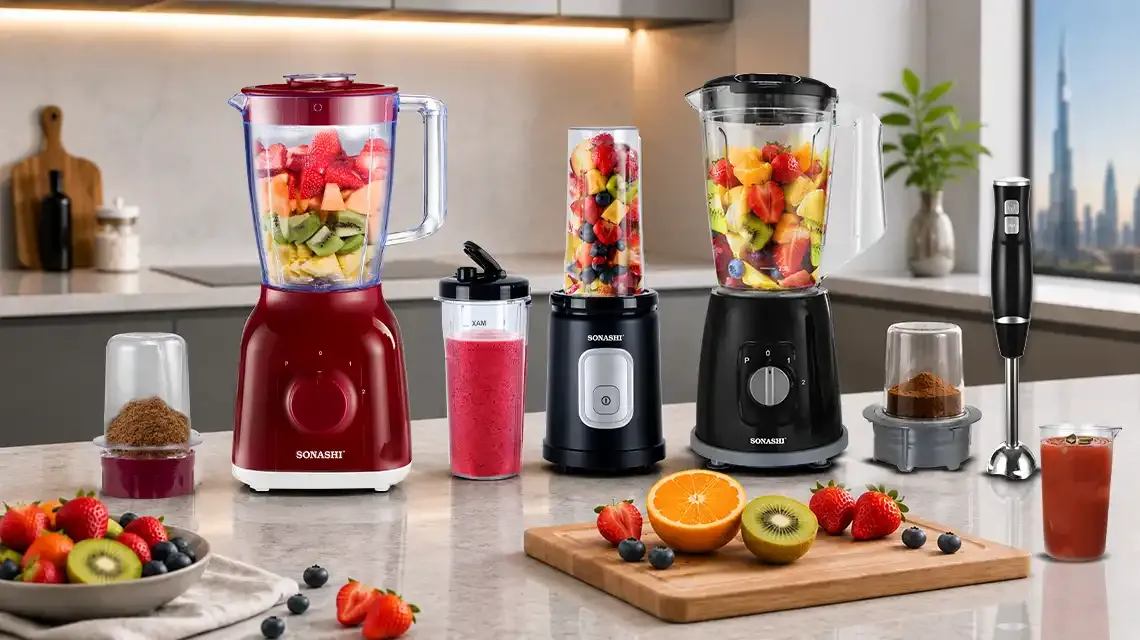
The modern home demands more from its appliances. Whether you are crafting a chilled mango lassi on a summer afternoon, processing tahini for a family gathering, or blending a quick post-gym protein shake before work, your blender is a daily-use tool that must perform consistently, safely, and intelligently.
This guide strips away the noise. It delivers clear, expert-led guidance on what to look for, what to avoid, and how to invest in a kitchen blender that genuinely serves your lifestyle at a price point that makes sense for the market.
What Is a Blender?
A blender is a multi-functional kitchen appliance designed to mix, emulsify, crush, puree, and liquefy ingredients at high speed. Unlike a food processor, which cuts and chops, a blender transforms ingredients into smooth, uniform textures, making it indispensable for both everyday cooking and specialised preparations.
At its core, every blender shares three essential components:
- The Motor: The powerhouse of the appliance. Measured in watts, it determines how efficiently the blender handles tough ingredients like ice, frozen fruit, or whole spices.
- The Blade Assembly: Stainless-steel blades positioned at precise angles to create a vortex of motion that pulls ingredients downward for consistent blending.
- The Jar / Jug: Available in glass, BPA-free plastic, or stainless steel. Capacity ranges from 0.6L personal blenders to 2L+ full-family pitchers.
Understanding these three elements is the foundation of every smart blender purchase decision.
Looking for a blender that combines performance, durability, and value? Explore Sonashi's latest blender collection to find a model that suits your kitchen needs.
Why Homes Need a High-Quality Kitchen Blender
The Emirates' unique lifestyle, a vibrant mix of cultures, cuisines, and climates, places exceptional demands on kitchen appliances. A low-quality blender that works adequately in a temperate climate may strain and overheat in the relentless heat, especially during months when ambient kitchen temperatures soar.
Consider the diversity of what residents blend on a daily basis:
- Fresh juices and smoothies – From tropical fruits, berries, and green vegetables central to health-conscious lifestyles.
- Hummus, baba ghanoush, and dips – Foundational to Levantine and Emirati home cooking.
- Spice grinding and wet masala - Essential for South Asian households that form a significant portion of residents.
- Protein shakes and meal replacement blends – fuelling the active fitness culture across Dubai, Sharjah, and beyond.
- Chilled beverages and crushed ice – a non-negotiable in a country with nine months of summer-like temperatures.
A quality kitchen blender UAE residents can trust must therefore be powerful, heat-resistant in its motor design, versatile in function, and built for daily usage, not occasional weekend use.
Technical Factors to Consider Before Buying
It’s important to understand the specifications that actually matter. These are the technical features that distinguish a good blender from a bad, expensive mistake.
Motor Power & Performance
Wattage is the most important specification for any blender. A higher wattage motor doesn't merely mean the blender blends at a higher speed. It blends at a consistent speed and blends harder substances while running cooler.
- 300–500W: Light blending — soft fruits, yoghurt-based smoothies, liquid soups. Not suited for ice or hard spices.
- 500–800W: Mid-range general-purpose performance — suitable for most household tasks in a kitchen.
- 800W–1500W+: High-performance — handles ice, frozen ingredients, nut butters, and dry grinding with ease.
For the typical household with diverse cooking needs, a minimum of 600–700W is advisable. If heavy-duty tasks like whole-spice grinding are part of your routine, look at 1000W and above.
Speed Settings & Controls
Variable speed control gives you precision control over texture. A one-speed blender is a blunt tool. It has one use. Multi-speed blenders with pulse control provide you with artistic control over every blending cycle.
Look for the blenders that have a minimum of three speed settings, a pulse control button, and, in more expensive blenders, a smoothie or ice crush program. These are not just gimmicks. They are important features that increase the blender's usability.
Jar Capacity & Material
Jar size should reflect your household size and typical batch volume. A 1.5L jar is standard and suits families of two to four. Larger households or those who batch-prep meals will benefit from a 2L jar.
As for material, glass jars are odour-resistant and scratch-resistant. and ideal for hot ingredients. BPA-free Tritan plastic jars are lighter, more impact-resistant, and often preferred for daily use. Avoid low-grade plastics that absorb colour and odour over time.
Blade Technology
The blade system determines the quality of the blend, not just the speed. Precision-ground stainless-steel blades maintain their sharpness over extended use. Look for cross-blade or multi-directional blade configurations — these create a more effective internal vortex that reduces unblended pockets and dead zones.
Removable blade assemblies are a significant maintenance advantage, allowing thorough cleaning and occasional replacement without requiring a full appliance change.
Voltage Compatibility
This is a non-negotiable specification for any appliance purchased in the UAE. The Emirates operates on a 220–240V, 50Hz electrical standard. Always verify that the blender is rated for this voltage before purchasing — particularly with imported units or parallel imports that may be built for 110V North American markets.
A voltage mismatch does not simply underperform. It can permanently damage the motor warranty. Reputable regional brands and authorised distributors always supply Emirates-compatible voltage ratings as standard.
Safety Features & Durability
- Thermal overload protection: cuts power if the motor overheats, which is critical in high ambient temperatures.
- Interlock lid mechanism: prevents operation unless the lid is securely sealed.
- Non-slip base: stable operation on countertops, especially during high-speed cycles.
- Suction-cup feet: additional stability during aggressive blending of hard ingredients.
- BPA-free certified materials: a health standard, not merely a marketing claim.
Types of Blenders Available in the UAE
Not all blenders are designed for the same purpose. Understanding the core categories helps you match the right tool to your actual lifestyle, rather than over-investing in a commercial machine or under-buying one that cannot serve your needs.
Blender Type | Best For | Power Range | Ideal User |
Soups, sauces, baby food, in-pot blending | 150W – 400W | Home cooks, minimalists | |
Personal/Portable Blender | Single-serve smoothies, protein shakes | 200W – 500W | Busy professionals, fitness goers |
Smoothies, soups, sauces, bulk blending | 500W – 1500W | Families & daily users | |
Multi-Function Blender | Blending, grinding, and chopping in one unit | 600W – 1000W | Versatile cooks need one appliance |
High-Performance Blender | Spices, nut processing, and daily commercial use | 1000W – 2000W+ | Health enthusiasts, semi-professional kitchens |
Which Blender Is Right for You?
The best blender for a kitchen is not the most expensive one; it is the one that precisely matches your household's usage pattern. Use this decision matrix to identify your category before evaluating products.
User Type | Needs | Recommended Blender Type |
Single or couples | Daily smoothies, quick prep, minimal storage space | Personal blender or compact countertop (500–700W) |
Family of 4–6 | Varied cooking, juices, soups, and large volumes | Full-size countertop blender (700W–1200W, 1.5–2L jar) |
Health & fitness-focused | Protein shakes, frozen smoothies, and ice crushing | High-performance blender (1000W+) with ice-crush mode |
South Asian / Middle Eastern cooking | Spice grinding, wet masala, hummus, chutneys | Multi-function blender with dry grinding jar (700W+) |
Chef/food enthusiast | Diverse textures, precision, and extended daily use | Variable-speed countertop blender (1000W–1500W+) |
Outdoor & travel lifestyle | Portable, rechargeable, compact use | USB or battery-powered personal blender |
Blender Price in UAE: A Budget Guide
Budget Range (AED 50 – 150) | Mid-Range (AED 150 – 300) | Premium Range (AED 300+) |
Basic 2–3 speed settings | Multi-speed + pulse control | Digital controls & presets |
300W – 500W motors | 600W – 900W motors | 1000W – 2000W motors |
Plastic jars, 1–1.5 litres | BPA-free or glass jars | Commercial-grade blades |
Suitable for soft fruits & liquids | Ice crush capability | Extended warranties |
Limited warranty support | Overload protection included | Quiet operation technology |
What Determines Blender Price?
Beyond wattage, pricing is influenced by build material quality, blade design sophistication, the breadth of included accessories (dry grinder jar, personal cup, and tamper), brand positioning, and after-sales service availability within the Emirates. A mid-range blender from an established regional brand with local warranty support often represents superior long-term value compared to a premium-priced imported unit with no authorised service centre.
Can I use my blender for a long time?
- Clean immediately after use
- Avoid overloading
- Use correct speed settings
- Check blade condition regularly.
Proper maintenance can extend lifespan significantly.
Smart Buyer Checklist Before You Purchase
Before completing your purchase online or in-store, run through this verification checklist. It takes a few minutes and can save you from a regrettable investment.
- Confirm the appliance is rated for 220–240V / 50Hz (the UAE standard).
- Verify an Emirates or GCC warranty is included, not a grey-market import warranty.
- Check that the motor wattage matches your primary use case (minimum 600W for general family use).
- Ensure the jar is BPA-free certified, as it is critical for daily food contact. Consumers can also review internationally recognised food-contact and product safety standards published by the International Organization for Standardisation (ISO).
- Confirm thermal overload protection is present; it is essential for kitchen environments.
- Look for a secure lid-lock mechanism, particularly important in homes.
- Look for included accessories that expand value (grinder jar, personal cup, recipe guide).
- Check blade removability for deep cleaning, especially if grinding dry spices.
- Compare the total cost of ownership, not just the listed blender price – warranty coverage matters.
- Review the brand's after-sales service presence in the UAE. Authorised service centres matter.
Once you apply the above checklist, the wide range of blenders in the market quickly narrows down to a few reliable choices. Factors like voltage compatibility, motor power, safety features, and local warranty support eliminate many products that may look appealing but fail in everyday use.
Among the brands that consistently meet these essential requirements, Sonashi stands out for offering a balanced combination of performance, durability, and UAE-focused support, making it a practical choice for modern households.
Why Choose Sonashi Blenders for Your Home
There are numerous blender brands available across the Emirates, yet Sonashi has established itself as one of the most trusted names in GCC home appliances. The brand has earned a reputation for consistent results and a clear focus on meeting the needs of local families.
Sonashi appliances are thoughtfully designed for the UAE market, built with 220–240V compatibility as standard, engineered to perform reliably in warm ambient conditions, and priced to deliver genuine value without inflated brand premiums.
- Reliable motor performance: across an extensive blender range from compact personal blenders to multi-function countertop units without compromising on build quality.
- UAE-specific support: authorised distributors, localised warranty coverage, and accessible after-sales service across the Emirates.
- Thoughtful multi-functionality: The blender models frequently include dry grinding jars, multiple jar sizes, and pulse controls, reflecting the real cooking diversity of households.
- Safety engineering: thermal overload protection, secure lid interlocks, and non-slip bases come as standard, not as premium add-ons.
- Warranty and support: We offer a 2-year warranty on all blender models. The service centre is available in Dubai, with technician support provided across the United Arab Emirates.
Whether you are a young professional in a Dubai apartment managing a compact kitchen or a family in Sharjah preparing meals for eight, there is a Sonashi blender calibrated for your reality. The brand does not position itself as the most glamorous choice on the shelf. It positions itself as the most dependable one.
Conclusion:
Choosing the best blender UAE kitchen comes down to practicality over hype. Focus on essentials like suitable motor power, correct voltage compatibility, and a jar size that matches your household needs. Instead of overspending on unnecessary features, opt for a dependable mid-range option that delivers consistent performance. Brands like Sonashi offer a balanced mix of affordability, durability, and local support—making them a smart, no-nonsense choice for everyday use.
Frequently Asked Questions
1. Can a blender grind spices and dry ingredients?
Yes, high-power blenders with strong blades can grind spices effectively.
2. What is the difference between a blender and a mixer?
A blender is used for liquids and semi-liquids, ideal for smoothies, purees, and emulsifying at high speed.
A mixer (stand mixer) is designed for solid and semi-solid tasks like kneading dough, whipping cream, and mixing batters. Both serve different purposes in the kitchen.
3. Which blender is best for smoothies?
Countertop or personal blenders with sharp blades and multiple speeds.
4. Is a glass jar better than a plastic jar?
Glass jars are more durable, scratch-resistant, and odour-free, making them ideal for hot ingredients. BPA-free plastic jars are lighter and more impact-resistant, suitable for daily use.