How to Choose an Extension Cord for Your Home: A UAE Buying Guide
A desk with a laptop, monitor and phone charger creates a different electrical demand from a kitchen with a kettle and microwave.
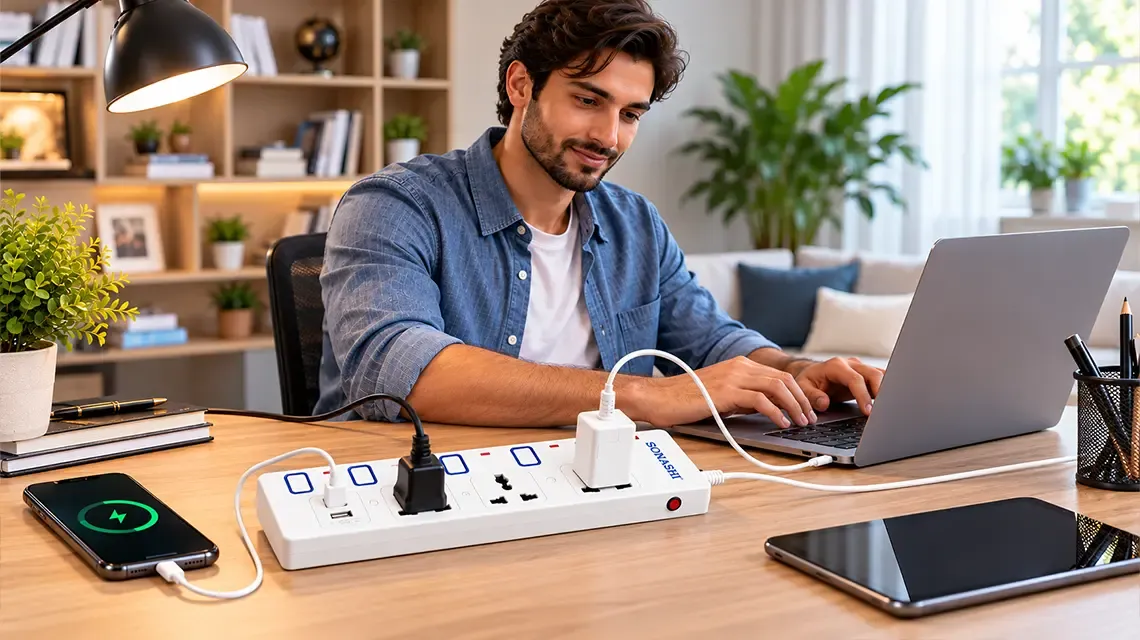
Understanding how to choose an extension cord starts with that distinction: match the lead’s rating to the combined load, check plug compatibility and measure the cable route before buying. In UAE apartments and villas, convenient socket placement matters, but extra outlets do not provide extra electrical capacity. Sonashi’s extension sockets offer options for household use; this guide explains which details to check before connecting your devices.
How to Choose an Extension Cord by Load Capacity
Check the extension lead’s maximum current, stated in amperes (A), and any total wattage limit. That rating applies to all connected devices together, rather than each outlet separately.
Read the input ratings on your appliances or their manuals. For chargers, use the mains input information rather than the USB output rating.
For a straightforward wattage calculation:
Total load = appliance 1 watts + appliance 2 watts + appliance 3 watts.
A 2,000 W kettle and a 1,500 W heater total 3,500 W. They should not share a lead rated below that combined demand.
Where only current is provided, watts can be estimated using volts × amperes for straightforward loads. A 13 A rating at 230 V corresponds to approximately 2,990 W, but this calculation does not override the manufacturer’s stated limit or appliance restrictions. Motors and some electronics require additional consideration.
How Many Devices Can You Plug into an Extension Cord?
The number depends on their combined demand and the lead’s instructions, not simply the number of sockets.
Four low-power devices may draw less than one heating appliance. Nevertheless, check every rating and leave capacity for equipment that switches on intermittently.
The Sonashi Extension Socket SES-804 lists four outlets, a 3-metre cord, an on/off switch, safety covers, overload protection and a maximum 13 A load. These features help buyers compare options, but four outlets do not mean four high-power appliances can run together.
For kettles, irons, heaters, air conditioners and other high-demand equipment, follow the appliance manual. Use a suitable wall outlet directly where instructed.
What Cable Length and Plug Type Should UAE Buyers Check?
Choose the shortest cable that comfortably follows a safe route. Measure around furniture rather than drawing a straight line across a walkway. Excess cable creates clutter, while a stretched lead puts pressure on connections.
UAE homes commonly use British-style Type G sockets with three rectangular pins. Check that the extension’s plug matches your wall outlet and that connected appliances fit correctly. Never force a plug or bypass an earth connection.
A “universal” socket does not convert voltage. Imported appliances still need a compatible supply rating.
For cable reels, follow the marked limits for wound and unwound use. Fully unwind the reel as directed to prevent heat accumulating within the cable.
Power Strip vs Extension Cord: What Is the Difference?
An extension cord extends the reach of a wall outlet. A power strip provides several outlets and often includes an attached extension cable. Neither description confirms surge protection or suitability for a particular appliance.
Feature | Why it matters | What to check |
Total load rating | Limits combined electrical demand | Marked amperes and watts |
Cable length | Affects placement and cable routing | Shortest practical route |
Plug and earthing | Determines compatible connections | Correct plug and required earth continuity |
Overload protection | Responds to excessive load | Explicit manufacturer specification |
Surge protection | Addresses certain voltage surges | Confirmed feature, not assumed |
Socket spacing | Accommodates bulky adapters | Plugs fit without obstruction |
Overload protection and surge protection perform different functions. A switch or fuse alone does not establish that a product protects electronics from voltage surges.
Which Extension Cord Safety Tips Matter Most?
Keep leads visible, dry and clear of rugs, doorways and furniture that could crush them. Never connect one extension lead to another.
Electrical Safety First’s extension-lead safety guidance explains why combined loads, damaged cables and daisy-chaining need attention. Stop using equipment with scorch marks, burning smells or damaged insulation.
In Dubai or Abu Dhabi homes, summer cooling needs can tempt households to add appliances to an already busy socket. Recalculate the load whenever equipment changes. Indoor extension sockets should not be used on damp balconies or near water unless specifically designed for those conditions.
When adding home appliances, check their connection requirements before planning socket use. Sonashi’s heritage dates to 1993, with distribution across more than 80 countries; still assess each product’s documented build details, protection features and official warranty terms individually.
Frequently Asked Questions
1. What is the best extension cord for home use?
The best extension cord for home use is one with a clearly stated load rating, compatible plugs and enough cable for a safe route. Choose socket count around your devices, then confirm their combined demand. Additional protection features are useful only when documented and appropriate to the intended use.
2. Can I connect an extension lead to another one?
No. Connecting extension leads together can overload the first lead or wall connection while making the total demand harder to track. Use one suitably rated lead with the required length instead. If extra sockets are regularly needed, ask a qualified electrician about installing appropriate permanent outlets.
3. Does a 13 A fuse mean each socket supports 13 A?
No. A multi-outlet lead’s stated maximum normally applies to the combined load across its outlets. The plug fuse does not provide separate capacity for every socket. Check the product’s instructions, total rating and connected appliance demand rather than multiplying the rating by the number of outlets.
Conclusion
Choosing an extension lead means matching electrical demand, plug compatibility and cable routing before considering socket count or price. Check the marked limit, follow appliance instructions and keep connections accessible for inspection. Explore the Sonashi extension-socket category linked above to compare documented features and warranty information. If your household regularly depends on extension leads for fixed appliances, discuss additional wall outlets with a qualified electrician.